Advertising campaigns and even peace talks between opposing groups share a surprising requirement: resonance. Without a genuine connection between the message and its audience, neither persuasion nor reconciliation can truly take hold.
The story begins a century ago, when German psychiatrist Hans Berger unveiled the electroencephalograph (EEG) in 1924. Berger’s breakthrough built on the pioneering work of Richard Caton and Adolf Beck, who first detected electrical activity in animal brains in the late 1800s. Their discoveries set the stage for a revolution in understanding how our minds connect and communicate.
In 1965, researchers Duane and Behrendt made history by simultaneously recording the brain activity of identical twins—a technique now known as “hyperscanning.” Separated by six meters, the twins showed a remarkable connection: when one closed their eyes, the other's alpha brainwaves shifted, hinting at a mysterious link between their minds.
Although this was the first hyperscanning study, the real surge in research on interbrain synchrony came decades later, fueled by advances in neuroimaging like fMRI in the early 2000s.
Carl Marci in 2007 reported that EEG synchrony between the brain of the psychiatrist and the patient is an important factor in helping patients release themselves from neurotic conditions. Carl later applied EEG synchrony to advertising, demonstrating that this brain signal is highly correlated with advertising effectiveness.
Wharton Neuroscience was the first to demonstrate that EEG synchrony strongly predicts the incremental sales effect of advertising, with an unmatched 0.91 correlation (and R Squared of 0.82). By comparison, the strongest correlation of other known predictors is the 0.48 R Squared reached by RMT Motivations, which was found to have this level of relationship with IRI sales by the Advertising Research Foundation Cognition Council.
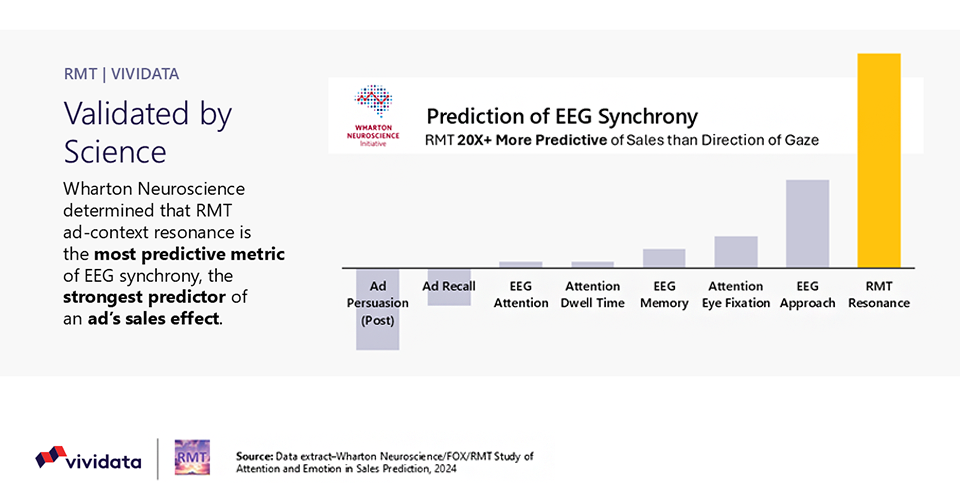
The key to effective advertising—and even bridging divides in our world—lies in resonance. When a message establishes genuine connection with its audience, it triggers synchronized brain activity and opens the door to persuasion. By using semiotic and semantic cues that signal shared values, and placing messages in resonant contexts, advertisers and communicators can maximize impact. Resonance isn’t just a scientific concept; it’s a practical strategy for driving engagement, fostering understanding, and creating real change.
Posted at MediaVillage through the Thought Leadership self-publishing platform.
Click the social buttons to share this story with colleagues and friends.
The opinions expressed here are the author's views and do not necessarily represent the views of