I am digging deeper into the over a hundred thousand different campaigns in the Nielsen ONE database covering linear, CTV, mobile, and computer. Nielsen, being a consulting client of mine, I have access to all this information, and Nielsen encourages me to find and publish useful empirical generalizations that will help marketers.
In this analysis, I wanted to go more deeply into the details and so purposely limited the number of campaigns I drew randomly to inspect. 7648 campaigns are included in this analysis, almost all of them from 2024-2025 (a handful from 2023). As in many prior analyses in this column, I am concentrating on how marketers can achieve high reach at the lowest cost.
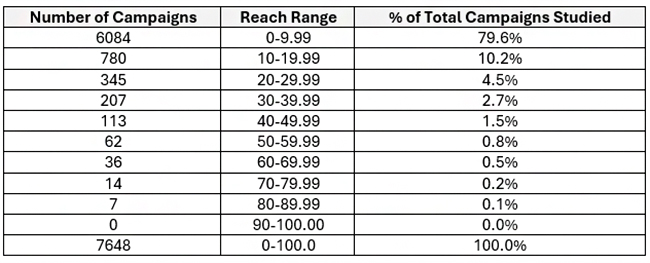
I started by ranking the campaigns from lowest to highest reach of persons 2+. This revealed that 6864 of these campaigns (9 out of 10) achieved less than a
Erwin Ephron, looking down at us from heaven, must be perplexed.
I, too, am surprised. I was very happy in 2023 when Marc Pritchard advised marketers to reach for coverage of
"We find that many brands just keep the bar too low and settle for target audience reach of around 50% to 70%," Marc said. "Now, why is it so low? We’re resetting the bar to achieve 90% target audience reach. And getting as close as possible to 100%. We want to reach all consumers and each consumer."
We see that Marc’s concern that 50-70% is too low is surely a wake-up call now that it’s revealed that only 1.3% of campaigns get to 50-70% reach, let alone above it.
I eyeballed the brand names in the hopes of seeing that the big-name brands are the ones near the high end of the reach spectrum, and the brands using the lower reach campaigns are all SMBs (small and medium-sized businesses). I did not see that. The big-name brands are distributed randomly throughout the list, and most of the campaigns are for big-name brands.
Some of these campaigns might have been directed at advanced audiences e.g., auto intenders. In those cases, 20% reach might have been nearly 100% of the target list. Also, some performance campaigns might not be considering reach at all, just the lowest cost per sale, without regard for scale. And some of the smallest campaigns we see might have been tests. So there could be good explanations for low reach in an unknown number of these cases.
Let’s take a closer look at the highest reach campaigns, those achieving the 80-89.99% range, to see what we can learn that can help us whenever we are seeking to maximize target reach at the lowest cost. Their GRP levels vary from 1234 to 1908. The highest reach campaign (89.5% reach) used 1480 GRP - an average frequency of 16.5.
Let’s deal with the common notion that reach is driven almost entirely by GRP. That is not the case. You can buy even more GRP than the level used by these few highest reach campaigns and not get significant reach. For example, I see here a campaign that used 2735 GRP and achieved a reach of only 12.0% -
All of the 80-89.99% reach campaigns used all four device types: linear, CTV, mobile, and computer. Linear, CTV, and mobile were used at about equal levels with computer quite a bit lower, roughly 30/30/30/10 on average.
Then there are some campaigns that have much higher GRP levels and substantially lower reach levels. For example, here is one with 14,515 GRP and a reach of 67.1% (average frequency 216). They used three out of the four device types, but skewed heavily to only one of them. There’s one that used linear and CTV heavily and less in mobile and computer, which got 76.1% reach with only 759 GRP - an average frequency of 10,
The takeaway: use all four device types; do not pile too much onto any one device type; use lower GRP On desktop. And of course, use dispersed schedules across many publishers in each device type. This will get you the highest reach at the lowest budget.
Once a month in this column, I’m going to be adding links to my latest podcasts about how to nurture the talent under your management and bring forth its creativity for maximum success at both a business and personal level. For example, this month’s subject is Resistance. What to suggest to yourself and your direct reports when feeling resistance inside to something that is going on. How to turn that uneasy feeling into a learning experience and flow state performance.
This month’s podcast length is ≈49 minutes. Watch the Video